
A Poster Presentation given at Resonance, in Montréal, Canada, June 2025
The original poster can be viewed as a whole here.
Introduction
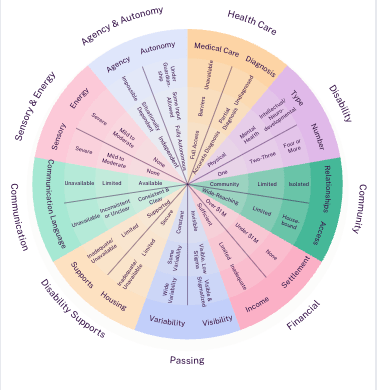
The traditional Wheel of Privilege and Power (WPP) does an excellent job identifying the various levels of power and privilege across a wide range of factors (“Wheel of Privilege and Power Resource,” 2025). What its presentation obscures, however, is the complexity of privilege and power present within the category of “visible and non-visible disability” that amplify the other intersectional realities present on the traditional WPP. A similar visual is needed to help communicate this reality. As Miranda Fricker notes, when individuals and communities lack language to refer to experiences it produces hermeneutical injustice. The goal of the Disability Wheel of Power and Privilege (DWPP) is to begin to push back against that lacuna.
Objectives
- To offer a preliminary model for a Disability Wheel of Privilege and Power.
- To concretize the complexity of power and privilege within the disability community.
- To create a starting point for deeper conversations about power and privilege within and beyond the disability community.
Methodology
Research to determine necessary categories was conducted using crip autotheory and embedded community engagement. The resulting Disability Wheel of Privilege and Power (DWPP) was then workshopped with key leaders in local disability justice groups for language, legibility, and completeness. Colours were chosen for colourblind safety, as well as to provide high visual contrast. Visual descriptions were recorded and linked using a qr code.
Results
Community feedback to date has been positive. Community members have articulated that the DWPP provides both visual and linguistic tools to address hermeneutical injustice (Fricker, 2011) as it pertains to the complexities of power and privilege within the disability community.
Analysis
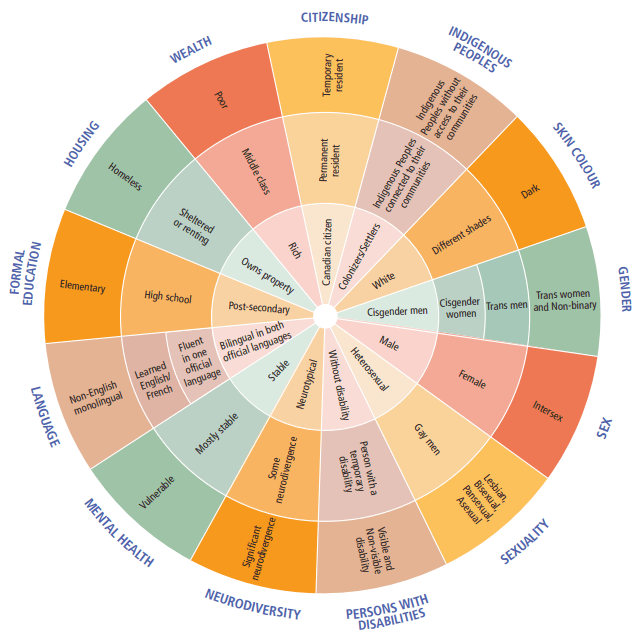
The Wheel of Privilege and Power (shown above), created by the Government of Canada, identifies thirteen aspects of intersectionality that contribute to a person’s privilege. It is designed to assist individuals and professionals in understanding the relationship of social identities to power and discrimination. In breaking open the three-fold simplicity of the disability category, however, sixteen sub-categories across eight primary categories were revealed to significantly impact the level of privilege and power maintained within or across the disability community. Five descriptions assist the user in understanding the terminology chosen:
- Accessibility in Housing includes not only physical access for mobility users, but also the supports needed to live independently, or safe space in a family or group home if independent living is not an option.
- Supports may include educational supports, mobility aids, guide/support dog, physio/occupational therapy, deaf/blind intervenors, PSW care, 1:1 workers, day programs, etc.
- Language refers to ways of communicating thoughts and ideas through speech, sign, protactile or AAC. Some people do not have any access to these forms of communication, but still communicate in ways that are often dismissed: for instance grunts, gestures, facial expressions, stims, etc.
- Sensory may include sensory losses like blindness/hearing loss, or may refer to sensory processing conditions. These impairments may be present at all times or only situationally.
- Agency has to do with capacity to act. Autonomy has to do with legal permission to make decisions for your own life. The two may or may not be correlated at any given time.
Conclusion
While the WPP is a highly valuable tool for understanding intersectionality, it lacks the ability to adequately represent the complexity of disability experiences. Statistics Canada’s “New Data on Disability in Canada” (2023) only begins to redress this concern, necessitating the development of a DWPP. The DWPP opens opportunities for self- and community-discovery, setting the stage for future research and engagement. The presented material should be seen as a preliminary model for the DWPP demonstrating its need. This DWPP would benefit from further consultation across a wider range of people with disabilities before a final version is released.
Wheels as Charts: Alternative Formats for Visual Accessibility
Traditional Wheel of Privilege and Power
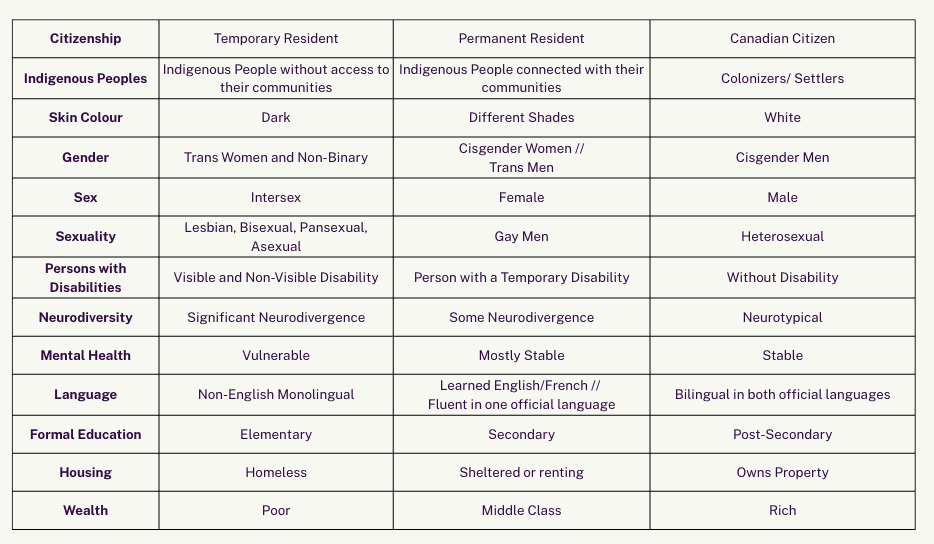
In the course of my research it became apparent that the Traditional Wheel of Power and Privilege is *not* accessible in its current visual form, because it has not been coloured for colourblindness, it does not meet WCGA standards for contrast, and it cannot be easily rendered into a visual description. As such, to increase accessibility, I have translated the wheel into a chart. The further to the right on the chart, the more privilege is represented.
Disability Wheel of Privilege and Power
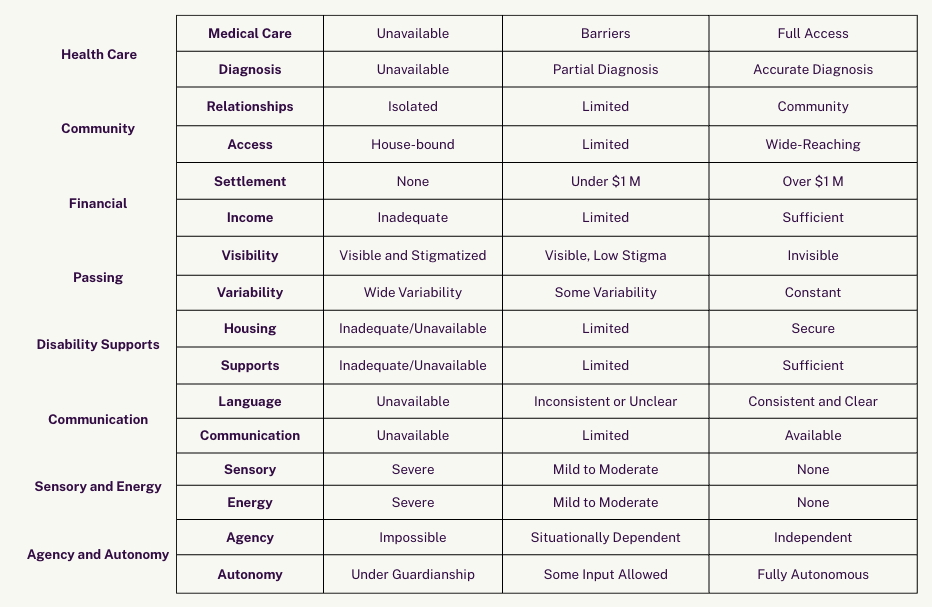
While I was able to address issues of colourblind access and contrast with the DWPP, nevertheless, the “wheel” shape remains cumbersome for visual descriptions. As such, to increase accessibility, I have translated the DWPP into a chart as well. As with the WPP, the further to the right on the chart, the more privilege is represented.
A Visual description of this project can be found at the QR code to the right, or by visiting: https://drive.google.com/file/d/1xIHysJoxVckyjHpgEWF1qdtDn9bXro7B/view?usp=sharing
 Heather Renée Morgan